


|
|
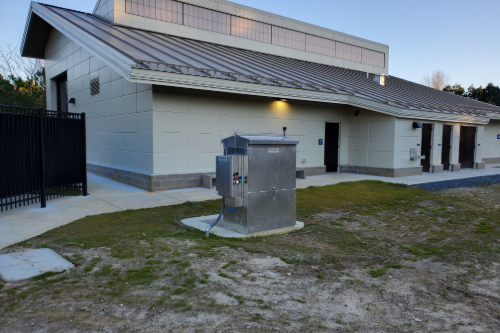
Pump stations designed for federal and military purposes have their own set of technical requirements that extend beyond those for the average industry. In addition to having their own standards for each type of application, there are federal registrations, common project partners, and more to keep in mind. Over the years, Excel Fluid Group has become familiar with these factors and the roles they play in bringing a federal project from design to completion.
Introducing UFGS Guidelines
When it comes to the execution of pump station projects for federal projects, Unified Facilities Guide Specifications (UFGS) Section 33 32 16 serves as the framework for wastewater solutions. Developed for use by the U.S. Army Corps of Engineers (USACE), Naval Facilities Engineering Systems Command (NAVFAC), and the Air Force Civil Engineer Center (AFCEC), these standards establish guidelines for packaged wastewater applications, with some flexibility for specific applications. The UFGS is regularly updated as federal design and construction practices evolve, making it important for manufacturers to stay up to date with the requirements in place for each job. At Excel, we've historically approached our military work this way, designing our systems around the current UFGS guidelines and project-specific specifications. While these technical requirements remain an important part of military construction, recent legislation is also changing how certain projects can be contracted and delivered.
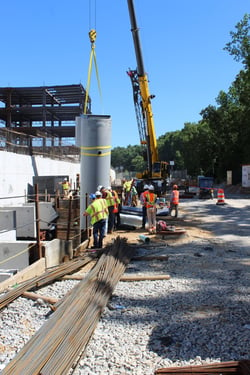 The UFGS guidelines extend beyond basic pump sizing and performance, covering several of the key components of pumping solutions including pumps, controls, piping, electrical components, and more. The specifications also incorporate requirements from established industry organizations such as American Water Works Association (AWWA), American Society for Testing and Materials (ASTM), and more. Instead of creating separate requirements, these standards help define specifications for individual parts of the overall system. As an example, AWWA standards are referenced for ductile-iron piping and valves to ensure that they can handle intense water pressure, while ASTM standards cover materials and structures such as HDPE, fiberglass, and precast concrete wet wells. For contractors and manufacturers, this means compliance considerations can extend down to individual components of the station.
Aside from the individual component requirements, UFGS also addresses how the pump station needs to operate as a complete system. The guidelines call for the pump supplier to supply a packaged solution with the pumps, controls, rail system, etc. all together in order to ensure seamless coordination throughout the system. This packaged approach may become even more relevant as the Department of Defense (DOD) adopts more collaborative project delivery methods. The FY2026 National Defense Authorization Act (NDAA) expanded acquisition flexibility for military construction, including authority for accelerated design-build and progressive design-build delivery. These approaches allow earlier collaboration among owners, designers, contractors, and equipment partners, improving coordination on infrastructure projects. Separate FY2026 authority also expanded the DOD's ability to use Other Transactions (OTA) for many facility repair and construction projects, providing another pathway for improved project delivery. For Excel, this added flexibility aligns well with our existing approach to packaged pump station delivery, where coordination between the different parties involved can help create a more complete solution. Regardless of the delivery method chosen, each station still needs to meet the UFGS guidelines and project-specific specifications established for the job.
Understanding Federal Registration Codes
A common inclusion for companies pursuing work with federal entities is a capability statement, which provides potential partners with a quick overview of their experience, products, services, and federal registration information. These capability statements are typically concise, often around one page, and contain a number of identifiers and classifications such as UEI, CAGE, and NAICS codes. SAM.gov (System for Award Management) is the official U.S. government website used to manage federal awards, business registrations, and procurement data. Excel's capability statement contains a number of identifiers and classifications associated with federal contracting, including:
-
Federal EIN (Employer Identification Number): 27-4195528
-
A unique number used to identify a business for federal tax purposes.
-
-
DUNS (Data Universal Numbering System): 05-336-2359
-
A 9-digit legacy business identifier formerly used for federal contracting.
-
-
NAICS (North American Industry Classification System):
-
237110 Water and Sewer Line and Related Structures Construction
-
333911 Pump & Pumping Equipment Manufacturing
-
These codes are used to classify a business by the types of work, products, and services it provides. A business can fall under multiple NAICS classifications, as is the case with Excel.
-
-
-
CAGE/NCAGE (Commercial and Government Entity): 5LM20
-
An alphanumeric identifier assigned to businesses that manufacture or supply goods or services to the U.S. federal government or military.
-
-
SAM# (System for Award Management): DAP4V87BJNW1
- Excel's identifier associated with its SAM.gov registration.
- Excel's identifier associated with its SAM.gov registration.
Although these codes all serve their own purpose, as a whole they provide standardized information about Excel's industry classifications and ability to participate in federal contracting opportunities. Having this information easily accessible helps federal agencies, contractors, and project partners determine who a company is, as well as what products and services they provide.
Working with Federal & Military Organizations
Pump stations in federal and military contexts can include a variety of organizations outside of the facility itself. Depending on what's needed for each station, pump station manufacturers may work alongside government engineering organizations, private utility operators, contractors, or a combination of these groups. Each can have a different role in determining the requirements of the system and carrying the job through completion.
 Further breaking down the groups typically affiliated with federal projects, we can look at two classifications: government engineering organizations and military utility partners. Starting with the engineering organizations, we can look to NAVFAC, USACE, and AFCEC. These organizations serve as some of the primary engineering and construction resources within the DOD, focusing on managing infrastructure and military construction for the United States Armed Forces. Part of their role is to help establish some of the technical requirements that manufacturers and contractors must account for on these projects, and they remain involved throughout the lives of the infrastructure they oversee. These organizations are also responsible for the development of the previously mentioned UFGS framework.
On the side of federal projects are utility partners, who serve a somewhat different role in the process. Military utility partners work with the DOD through the Utilities Privatization program to take responsibility for key infrastructure on military bases. Depending on the agreement, these partnerships can include ownership, operation, maintenance, and long-term oversight of these systems. While utilities may expand beyond water and wastewater, these areas are most relevant to pump station solutions. Some companies have developed dedicated operations to serve military installations such as American States Utility Services, commonly known as ASUS, or American Water Military Services Group. Both of these organizations own and operate a number of water and wastewater systems throughout the country.
 Because these organizations are responsible for the long-term operation of the utilities they manage, their involvement can extend well beyond simply keeping an existing system running. Agreements can include infrastructure renewal and replacement, giving utility partners a direct role when aging equipment needs to be upgraded or new systems are required. ASUS, for example, performs operation, maintenance, renewal, and replacement work under its military utility agreements. This is where companies such as Excel can become involved, supplying pump station solutions designed around the needs of the installation and the requirements established for the job.
Excel's Federal Project Experience
Excel has supplied pump stations for a variety of federal and military facilities, each with its own application and project requirements. From concrete to HDPE and beyond, the following case studies showcase several of these jobs and the different pump station solutions assembled to meet their requirements.
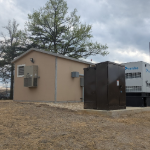 |
Joint Base Andrews - Water Booster Pump Station For the Andrews Air Force Base in Maryland, Excel and ASUS delivered a water booster pump station designed to address persistent pressure issues and support the reliability demands of a federal military installation. |
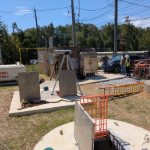 |
Indian Head, Maryland Navy Base Pump Stations Working with Etolin Strait, Excel Fluid Group designed and built multiple turnkey pump stations for the Indian Head, Maryland Naval Support Facility and Stump Neck Annex to replace failing infrastructure and modernize critical pumping systems. |
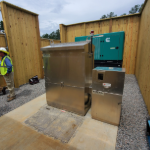 |
Fort Bragg SERE Training Complex Pump Station For Fort Bragg's training complex in North Carolina, Excel Fluid Group and ASUS worked together to design a compact NoVault wastewater pump station for the project's limited space, complete with an HDPE wet well. |
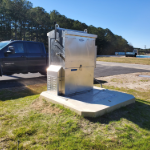 |
NAVFAC Mid-Atlantic Pump Stations For Naval Station Norfolk, Excel Fluid Group designed two NoVault wastewater pump stations with fiberglass wet wells to provide Navy personnel with easier access and maintenance. |
Aside from these four highlighted projects, more examples of our work in the federal and military spaces can be seen here. This page will continue to grow as we complete and document additional projects.
Federal and military pump station work requires an understanding of the requirements that shape each job from design through completion. With experience across a range of federal and military facilities, Excel Fluid Group has become familiar with this process and what it takes to develop solutions around the needs of each application.
Federal requirements can also extend beyond pump station design. Depending on the job, domestic sourcing requirements such as the Build America, Buy America Act (BABA) may also apply. To learn more, read our Build America, Buy America Act Compliance blog.