


Municipal
Challenge:
Recurring flooding near Eaton Lane in West Islip, New York required a stormwater solution. Bayside site conditions, limited site access, capped electric service, and weather delays added obstacles to project fulfilment.
Solution:
Excel worked closely with the contractor to guide design and adapt the system for coastal conditions, incorporating protective measures to help support long-term use and maintenance. Pump selection and VFD controls enabled required flow rates while staying within available electrical capacity, and the station was resized to meet access constraints. Startup was completed successfully despite weather delays.
Pump Station Details:
Precast Concrete Wet Well, NEMA 4X 304SS Duplex Pump Station Control Panel, BARNES Submersible Envie³ Pumps with Epoxy Coating, AIS Rated Pump Station Piping & Fittings
About the Client:
 |
|
|
|
ContractorWaterside Contracting Corp. is a marine construction company specializing in the building, repair, and maintenance of waterfront structures, including piers, bulkheads, docks, fender systems, and seawalls for residential and commercial applications. Their services include pile driving, dredging, and sheeting installation. As a small, woman-owned business with over 15 years of experience, they provide hands-on service and close client collaboration. |
 |
Pump Station End UserThe Town of Islip, located on the South Shore of Long Island in Suffolk County, New York, is a bayside community known for its maritime setting along the Great South Bay. With a mix of residential neighborhoods, marinas, and waterfront access, the area serves as a key gateway to Fire Island, with ferry service connecting residents and visitors to its beaches and coastal communities. |

The Challenge:
Located along Eaton Lane near a ferry terminal in Islip, New York, the project area had been experiencing recurring issues with flooding that created a need for a stormwater runoff solution. The bayside setting introduced additional complexity, as the system had to perform long-term in an environment where brackish water conditions and storms would consistently wear on the station.
The project also required close coordination with Waterside Contracting Corp., with Excel providing additional support throughout the pump station design and engineering process. This collaborative effort ensured alignment on system requirements, installation considerations, and overall project execution.
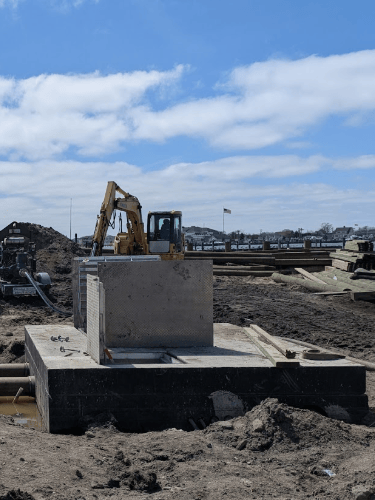
As the design progressed, material selection became an important factor to ensure that the station could withstand corrosion from continuous exposure to saltwater. The existing electrical service was limited to 40 amps, requiring coordination to identify pumps capable of meeting 2,650 GPM (3.81 MGD) per pump without overloading the system. Site access constraints also presented a logistical challenge, as the crane being used for delivery was unable to position the station due to its weight, requiring modifications to the tank's dimensions. Weather-related delays further impacted the project timeline, complicating delivery and installation.
The Solution:
Excel Fluid Group provided support to stakeholders throughout the project to help align the system design with site conditions and installation requirements. To address the coastal environment, epoxy coatings were applied to the pumps, and the electrical and mechanical components were placed on an elevated platform, slightly removed from the wet well. The precast tank also included New York State third-party PE design certifications to meet state requirements, as well as H-20 traffic rated hatches to support occasional traffic. The system was also designed to return collected stormwater back into the bay, supporting runoff management for the surrounding area.
Pumps were carefully selected to meet required flow rates while operating below 40 FLA, and variable frequency drives were incorporated to allow for controlled, variable speed operation within the site's electrical limitations.
When site access constraints and the weight of the wet well prevented the crane from setting it in place, the concrete tank was redesigned with adjusted dimensions. The adjusted product had reduced size and weight, allowing for a successful placement within the site constraints.