


Pump Station Applications in the Aviation Industry
Airports are a big business with landing fees, fuel fees, baggage fees, and more. The airlines that operate there know it, with the more gates they control, the more passengers they serve, and the more revenue they generate. Take O’Hare National Airport in Chicago, for instance. United is the airport’s biggest airline, followed by American; they invest billions of dollars via revenue agreements to fund the construction projects to expand the terminal gate capacity.
“Ultimately, it’s a revenue stream for them,” says Carl Wootten, Vice President of Business Development for Excel Fluid Group. “It’s in their best interest to invest in infrastructure to improve the passenger’s experience.”
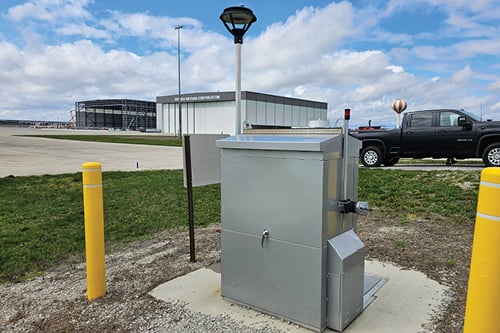
But not all of that infrastructure is visible to passengers. Behind the scenes, airports face pumping challenges that are unique to aviation. Aviation pump stations help move and manage water and wastewater across airport facilities where it cannot be handled by gravity drainage alone. In addition to general sanitary wastewater, unlike most facilities, airports produce waste that needs special handling. Glycol run-off from deicing, firefighting foam containing forever chemicals (PFAS), and runway stormwater can’t drain on their own. Each waste stream requires its own pumping solution. EFG has delivered airport pump station solutions for these and other applications at both major hubs and regional airports.
Types of Airport Pump Station Applications
Airports require different types of pump stations depending on the water or wastewater application. Here are five of the most common, each of which EFG has a solution for.
-
Wastewater: Any building that can’t drain waste by gravity alone needs a pump station to move it off-site.
-
Glycol Recovery: When planes are deiced, a mix of water and glycol runs off the aircraft. Airports collect this runoff and are required to monitor and report total organic carbon (TOC) levels to regulators to stay within pollutant discharge limits. Pump stations move and manage this water through the recovery process.
-
Stormwater: Any rainwater that falls on or near the runway must be pumped away off site. Planes cannot land if there’s standing water on the airfield.
-
Fire Suppression Containment: Airport hangars and fire trucks use a specialized foam for fire emergencies. After any suppression event, the foam has to be fully drained and pumped out through a pump station to avoid soil contamination from PFAS.
-
Water Booster Stations: Water Booster Stations increase water pressure beyond what the city water line can provide. Individual buildings can handle this internally with mechanical pumps, but a booster station can manage water pressure more efficiently for a bigger facility.
Installing the right pump station is only half the challenge. Maintaining it safely is the other.
Putting Safety First: Dayton International Airport
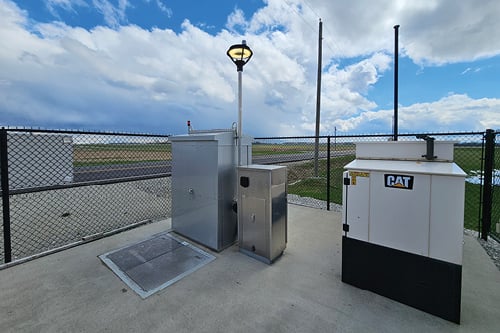 Before partnering with EFG, Dayton International Airport had five dry well pump stations that were originally designed in the 1970s. They were long overdue for an upgrade because the infrastructure was failing, and maintaining the pump stations was an ongoing maintenance headache.
The dry wells on-site sat 25-30 feet underground. Any time they needed to be serviced or visually inspected, a technician had to descend a ladder to complete the task—this is also known as a confined space entry.
“Confined space entries are hazardous, musty, and wet,” Wootten says. “We worked with Dayton International Airport to eliminate below grade confined space entry through our packaged pump station design.”
The project, which involved five pump stations in total, was completed in 2021 and eliminated confined space entry completely.
Managing Wastewater at Scale: O’Hare International Airport
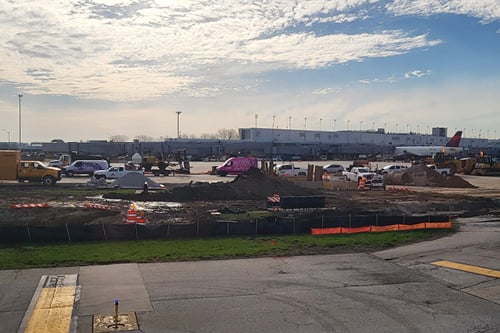 EFG has provided packaged airport pump station solutions for multiple projects at O’Hare International Airport in Chicago, including the now completed Terminal 5 Parking Garage expansion. For the ORDNext Terminal Redevelopment Program, EFG is working with HNTB Corporation to provide a sanitary pump station that will ultimately serve the new satellite Concourses D and E, as well as the new Midfield Cooling Plant. As the Lead Engineer for the Program, they required a site-specific pump station that manages the 2.45 MGD of wastewater from the new facilities.
The wastewater generated from Concourses D and E will flow into an 11 ft. diameter by 45 ft. deep HDPE wet well with a separate 11 ft. diameter by 10 ft. valve vault. Packaged complete with a channel grinder, the solution allows for a 3rd Party P.E. certified pump station with a faster installation, and a more reliable long-term solution.
“From a designer and contractor’s perspective, prepackaged pump station solutions are really the most efficient way to go,” says Shawn Gould P.E., Aviation Department Manager for HNTB. “It’s a one-stop shop. All the components are pre-fitted to work together, so it makes the designer’s life easier and ensures you have a fully functioning system.”
The new Satellite Concourse D project is currently under construction and is scheduled to open in 2028. It is one of several infrastructure investments at O’Hare, with multiple stormwater and sanitary wastewater pump stations currently in design and construction planned for next spring.
Protecting the Environment: Miami International Airport
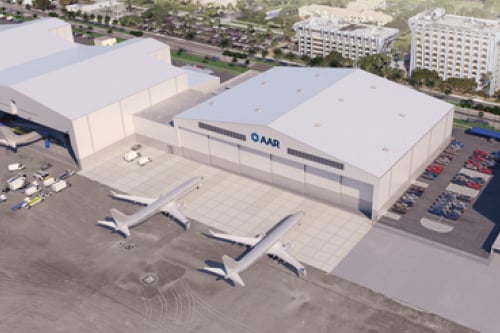 At Miami International Airport, EFG worked with Volkert on a pump station solution to contain fire suppression foam from an airport hangar.
“If there’s a fire in the hangar, the foam suppression system from the ceiling goes off and puts the fire out,” Wootten says. “When they spray the foam, which can be between six to 10 feet thick, it breaks down and goes into a containment lift station or sump.”
The foam is then pumped into a truck and transported to another treatment facility. This prevents PFAS from contaminating the groundwater, which can cause a multitude of other problems.
Clearing the Runway: John Glenn Columbus International Airport
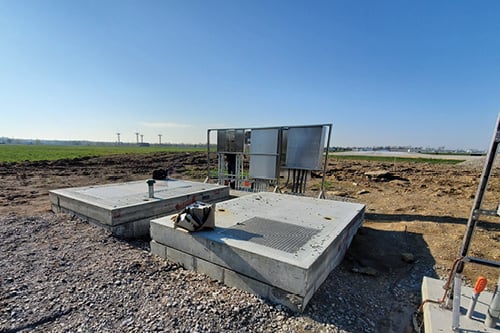 At the John Glenn Airport in Columbus, Ohio, EFG assisted in a deice pad extension project for the tarmac with BF&S.
“This deice pad extension helped aircraft get to their destinations more efficiently during winter weather as it could accommodate more planes simultaneously." Wootten says. "It removed the deicing operation from the terminal gates, eliminating congestion, accelerating aircraft turnaround times, and incorporating specialized drainage infrastructure to capture and recycle glycol-based deicing fluids."
The deiced water runoff is then pumped to an existing diversion structure on site. Designed for a 10 year winter storm, the pumps were rated for 3.6 MGD.
Embracing the One-Stop Shop Solution
From replacing aging infrastructure to managing stormwater and containing fire suppression foam, the pump station challenges airports face are rarely simple. Each application comes with its own regulatory requirements, site constraints, and operational demands.
For EFG, that’s the whole point, their process doesn’t change. From design through installation to ongoing service, they serve as a single point of accountability for every project. They deliver packaged pumping systems for airports - sanitary, stormwater, and glycol recovery - with proven installations at major hubs and regional airports. They've supported aviation engineering teams with early design assistance, application expertise, and phased based approach that reduces risk and ensures compliance with FAA 150/5320-15A requirements in active airport environments.
Frequently Asked Questions
What is an aviation pump station?
An aviation pump station is used to move and manage water or wastewater across airport facilities where gravity drainage alone is not sufficient. Applications can include sanitary wastewater, stormwater, glycol recovery and fire suppression containment.
What types of pump stations are used at airports?
Airports can require several types of pump stations, including wastewater pump stations, stormwater pump stations, glycol recovery systems, fire suppression containment systems and water booster stations.
How are wastewater pump stations used at airports?
Airport wastewater pump stations collect and move sanitary wastewater from terminals, concourses and other facilities where it cannot drain by gravity alone. The required capacity and configuration depend on the facilities being served and the site conditions.
How do airports manage stormwater?
Airport stormwater pump stations help remove collected rainwater from runways, taxiways and other areas where standing water can affect airport operations. The water can then be moved to the appropriate drainage or stormwater management system.
What is a glycol recovery pump station?
A glycol recovery pump station helps collect and move runoff produced during aircraft deicing. This allows airports to manage glycol-containing water separately and support the monitoring, recovery or treatment processes required for the site.